Yes, you can access therapy in Mandarin or Cantonese in Toronto. Many private practices, community clinics, and non-profit organizations offer therapy in these languages, with options for both in-person sessions in Toronto and virtual sessions across Ontario.
Reaching out for mental health support can already feel overwhelming, especially when you're unsure how to put your experiences into words. Sometimes, expressing your emotions in English doesn't quite capture what you're feeling. You may find yourself struggling to explain certain family dynamics, cultural expectations, or experiences that are difficult to translate.
Working with a therapist who speaks your preferred language and understands your cultural background may help you feel more comfortable expressing yourself without having to explain or translate every aspect of your experience.
In this guide, we'll explore where to find Mandarin- and Cantonese-speaking therapists in Toronto, what to consider when looking for a culturally responsive therapist, what to expect in your first therapy session, and how much therapy may cost.
Key Takeaways
Therapy is available in Mandarin and Cantonese: Many private practices, community clinics, and non-profit organizations in Toronto offer therapy in one or both languages.
Consider cultural understanding beyond language: Look for a therapist who understands the cultural nuances, family dynamics, and experiences that may be relevant to your life.
Check your insurance coverage: If you have extended health benefits, confirm whether your plan covers services provided by Registered Psychotherapists (RPs) or Registered Social Workers (RSWs) before booking.
Explore affordable therapy options: Private therapy sessions may range from $140 to $220, depending on the provider. Low-cost therapy, sliding-scale fees, and publicly funded services may also be available.
Consider virtual therapy: If you have difficulty finding a Mandarin- or Cantonese-speaking therapist near you, practices such as True Resilience Psychotherapy offer virtual therapy across Ontario.
Make use of free consultations: A consultation is an opportunity to ask questions, share your concerns, and get a sense of whether you feel comfortable working with a therapist before committing to a session.
Can I see a therapist in Mandarin or Cantonese in Toronto? Where to start
Finding a therapist who speaks your preferred language can feel overwhelming, especially when you're unsure where to begin. Fortunately, there are several resources available in Toronto to help you find a Mandarin- or Cantonese-speaking therapist who meets your needs.
Online directories with language filters
Psychology Today's Toronto therapist directory allows you to search for Mandarin-speaking therapists and Cantonese-speaking therapists. If you're comfortable speaking either language, consider searching under both language filters to explore more options. Other directories you may find helpful include TherapyRoute and First Session.
When browsing directories, keep in mind that the languages listed on a clinic's profile may not reflect the languages spoken by every therapist on its team. It's helpful to reach out directly to confirm whether the therapist you're interested in can conduct sessions in your preferred language.
Clinics with Mandarin- and Cantonese-speaking therapists
Several psychotherapy clinics across Toronto offer counselling and psychotherapy in Mandarin and Cantonese. Scarborough Psychotherapy Services on Sheppard Avenue East, Toronto Psychology Clinic on Carlton Street, Wellnest on Yonge Street, and HealthOne Mental Health on Harbour Street all list therapists offering sessions in Mandarin, Cantonese, or both.
At True Resilience Psychotherapy, our practice is centered around this need. We recognize that language and cultural background can play an important role in how we understand ourselves, express our emotions, and navigate our relationships.
Our team of Asian therapists offers trilingual sessions in English, Mandarin, and Cantonese; they don't just speak the language, they've lived the same cultural intersections our clients are navigating. That's a different thing than having one bilingual therapist on a roster. We offer a free initial consultation to match you with the right therapist from the start, so you're not arriving for your first real session and hoping for the best.
Community and nonprofit options
If the cost of private psychotherapy is a concern, there are also publicly funded and non-profit organizations in Toronto that provide mental health support to Chinese-speaking communities.
Hong Fook Mental Health Association provides counselling in Cantonese and Mandarin for clients aged 16 and up, with services that include individual counselling, psychiatry, peer support, and group programming.
Community Family Services of Ontario, formerly Chinese Family Services of Ontario, also offers individual, group, and family counselling.
These programs typically carry longer wait times than private therapy, often several weeks to a few months, but they remain a meaningful option for clients who qualify. We always encourage you to contact these organizations directly to learn more about their services and current availability.
You may also wish to explore private practices that offer sliding-scale fees or low-cost therapy if affordability is an important consideration when looking for mental health support.
What makes a therapist culturally informed?
While speaking the same language can help you feel more comfortable in therapy, it doesn't necessarily mean that your therapist understands your cultural background or how it has shaped who you are. Both are important considerations when finding a therapist you feel comfortable opening up to.
Cultural understanding goes beyond language
A bilingual therapist and a culturally informed therapist are not necessarily the same. A therapist may speak fluent Mandarin, but have limited understanding of the importance of family obligations, interdependence, and collective well-being in some Chinese families.
A culturally informed therapist considers how your cultural background may influence your mental health. This could include navigating stigma around seeking help, feeling pressure to succeed while struggling emotionally, or balancing two cultural identities while trying to develop your own sense of belonging.
At True Resilience Psychotherapy, our approach to therapy recognizes the importance of cultural identity, family values, and the unique experiences of individuals growing up in Asian and immigrant households.
Questions to ask before you book
A free consultation is a great opportunity to learn more about a therapist's experience and approach. Here are a few questions you may find helpful:
Have you worked with Chinese-Canadian clients navigating family expectations or intergenerational conflict?
How do you take into consideration the ways collectivist values shape the way people think about mental health and asking for help?
Can we conduct our sessions in Mandarin or Cantonese, or switch between languages if needed?
It's okay to ask these questions before starting therapy. Finding a therapist who respects your cultural values and with whom you feel understood is an important part of building a comfortable and trusting therapeutic relationship.
What to expect at your first appointment
Your first session is typically a conversation about what brought you in, your goals, and some relevant background on your mental health history. With a bilingual therapist, you can speak in the language that is most comfortable, from the beginning. You don't have to find the English word for something you've only ever felt in Mandarin.
Many culturally informed therapists will explore your cultural background and family dynamics to better understand how these experiences have shaped you. However, your cultural background is only one part of who you are. A culturally informed therapist will approach your experiences with curiosity rather than assumptions, making room for your individual values, perspectives, and experiences.
Before your first session, check your therapist's credentials. In Ontario, Registered Psychotherapists (RPs) and Registered Social Workers (RSWs) are the designations most commonly covered by extended health benefits through employers. Your plan may also distinguish between an RP and an RP (Qualifying), and some plans specifically require an MSW alongside the RSW designation, so confirm the details with your plan administrator before you book.
No referral is needed for private therapy in Ontario - you can just book with a clinic directly.
What does therapy cost, and are there lower-cost options?
The cost of therapy can be an important consideration when deciding whether to reach out for support. Understanding the different options available can help you find mental health support that fits your needs and budget.
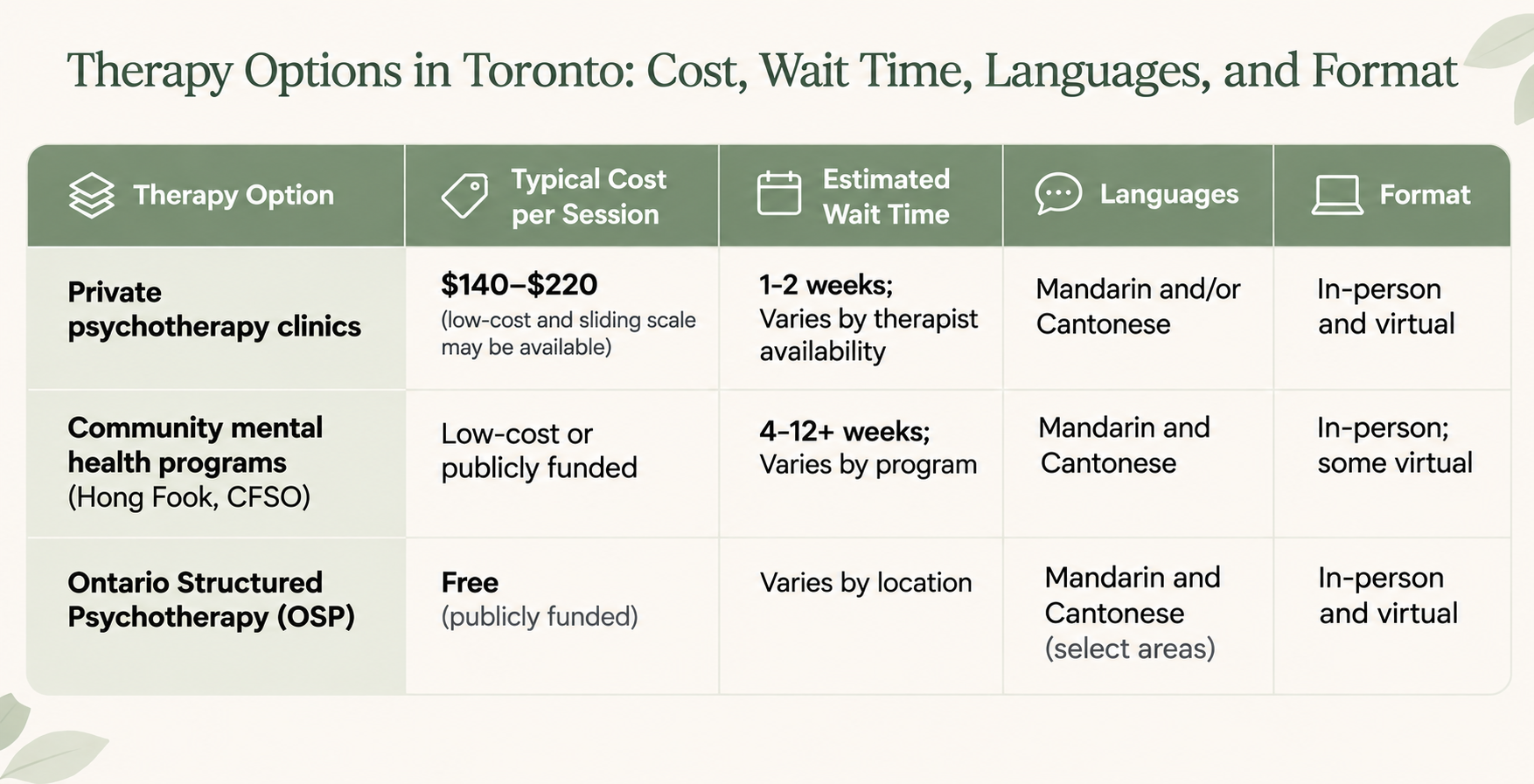
Many extended health benefit plans cover services provided by Registered Psychotherapists (RPs) and Registered Social Workers (RSWs), which may help reduce your out-of-pocket expenses.
At True Resilience Psychotherapy, we offer low-cost therapy through therapists in training, making ongoing therapy more accessible for individuals who may have financial concerns. We also offer a free consultation where you can learn more about our services and discuss your options before starting therapy.
Some private practices also offer sliding-scale fees based on financial circumstances, and sessions with therapists in training costing approximately $40 to $100 per session.
OHIP generally does not cover psychotherapy provided by registered psychotherapists or social workers in private practice in Ontario. However, the Ontario Structured Psychotherapy program offers free, government-funded cognitive behavioural therapy (CBT) for eligible adults experiencing anxiety or depression. We recommend contacting the program directly to confirm language availability, eligibility requirements, and current wait times.
Can I see a therapist in Mandarin or Cantonese online in Ontario?
Yes, virtual therapy makes it easier to access Mandarin- and Cantonese-speaking therapists across Ontario, regardless of where you live.
Several practices and therapist-matching platforms, including Fen Psychotherapy and Counselling, Layla Care, Inner Room, and First Session, can help you find bilingual therapists offering online sessions. Language availability may vary by therapist.
At True Resilience Psychotherapy, we offer virtual therapy in Mandarin and Cantonese across Ontario, alongside in-person appointments in Toronto.
Whether you live in Scarborough, Markham, Mississauga, or elsewhere in Ontario, virtual therapy allows you to access support in your preferred language without the commute, helping it fit into your busy life.
Online therapy may be more convenient if you have a busy schedule or feel more comfortable in your own space. In-person therapy may be preferable if you value face-to-face connection or having a dedicated space away from your everyday environment.
There is no single format that works best for everyone. Consider discussing your preferences with your therapist to find an arrangement that suits your needs.
Ready to take the next step?
Finding a Mandarin- or Cantonese-speaking therapist in Toronto may be more accessible than you realize. Whether through private practices, community clinics, virtual therapy, or publicly funded programs, there are several options to explore based on your needs, preferences, and budget.
Finding a therapist who understands your language and respects your cultural background may help you feel more comfortable opening up and exploring experiences that are difficult to put into words.
At True Resilience Psychotherapy, we offer therapy in English, Mandarin, and Cantonese, with a particular focus on Asian and immigrant experiences. Whether you're navigating family expectations, cultural identity, relationship difficulties, or other mental health concerns, we welcome you to explore these experiences at your own pace.
If you're considering therapy but are unsure where to begin, we invite you to book a free consultation. It's an opportunity to speak with a therapist, ask questions, and explore whether working together feels like a good fit, without any obligation to book a session.
Frequently Asked Questions About Mandarin and Cantonese Therapy in Toronto
Is Mandarin-speaking therapy available in downtown Toronto and surrounding areas?
Yes. Mandarin-speaking therapists are available through private psychotherapy clinics, community organizations, and virtual therapy services across Toronto and Ontario. Practices like Toronto Psychology Clinic on Carlton Street and Fen Psychotherapy offer in-person options, while practices such as True Resilience Psychotherapy also offer virtual therapy to individuals living in Markham, Scarborough, Mississauga, and other areas of Ontario.
How do I confirm that my therapist speaks Mandarin or Cantonese?
Before booking, we recommend contacting your therapist directly and asking: "Will our sessions be conducted in Mandarin (or Cantonese)?"
The languages listed on a clinic's profile may not reflect those spoken by every therapist on its team. A free consultation is also an opportunity to confirm language availability and explore how comfortable you feel communicating with your therapist.
Does insurance cover Mandarin or Cantonese therapy in Toronto?
Extended health benefit plans may cover sessions with a Registered Psychotherapist (RP) or Registered Social Worker (RSW), regardless of the language spoken during therapy. We recommend checking with your insurance provider, as coverage, reimbursement limits, and professional designation requirements may vary. OHIP generally does not cover psychotherapy provided by registered psychotherapists or social workers in private practice.
What's the difference between bilingual counselling and culturally informed therapy?
Bilingual counselling allows you to communicate with your therapist in your preferred language. Culturally informed therapy takes into consideration how your cultural background may have shaped your experiences. This may include family dynamics, intergenerational expectations, cultural identity, and stigma surrounding mental health and seeking support.
While both can help you feel more understood in therapy, it's also important to find a therapist who approaches your individual experiences with curiosity rather than assumptions.